Good Documentation Practice for Aesthetic Practitioners
CPD & Clinical Standards
Good Documentation Practice for Aesthetic Practitioners
In aesthetic medicine, your records are your clinical memory, your legal defence, and your professional signature. Here is what good documentation really means — and how to get it right.
There is a principle every practitioner should carry into clinic: if it was not written down, in the eyes of a regulator, an insurer, or a court, it did not happen. The most common cause of successful complaints against aesthetic practitioners is not poor clinical outcomes — it is poor documentation.
What Good Documentation Practice Means
Good Documentation Practice (GDP) is the set of standards ensuring that clinical records are created, maintained, stored and, eventually, disposed of in a way that is accurate, complete, consistent and traceable. Although the term originates in Good Clinical Practice and pharmaceutical quality systems, it now underpins record-keeping expectations across regulated healthcare — from CQC inspection standards to the professional codes of the GMC, NMC and GPhC. For aesthetic practitioners working in a lightly regulated but increasingly scrutinised field, GDP is not bureaucracy. It is the discipline that protects your patients and your practice.
The ALCOA+ Principles
The most widely used framework for record integrity is ALCOA+, adopted in the MHRA’s data-integrity guidance. Every record you create should meet each of these criteria:
Attributable
— it is clear who recorded the information and when.
Legible
— readable and permanent, whether handwritten or electronic.
Contemporaneous
— recorded at the time the event took place, not reconstructed later.
Original
— the first capture of the data, or a certified true copy.
Accurate
— free from error and a true reflection of what happened.
Complete
— nothing missing, including any amendments and the reason for them.
Consistent
— logical and sequenced, with dates and times in order.
Enduring
— durable and retained for the full required period.
Available
— retrievable whenever it is legitimately needed.
What to Record at Every Consultation
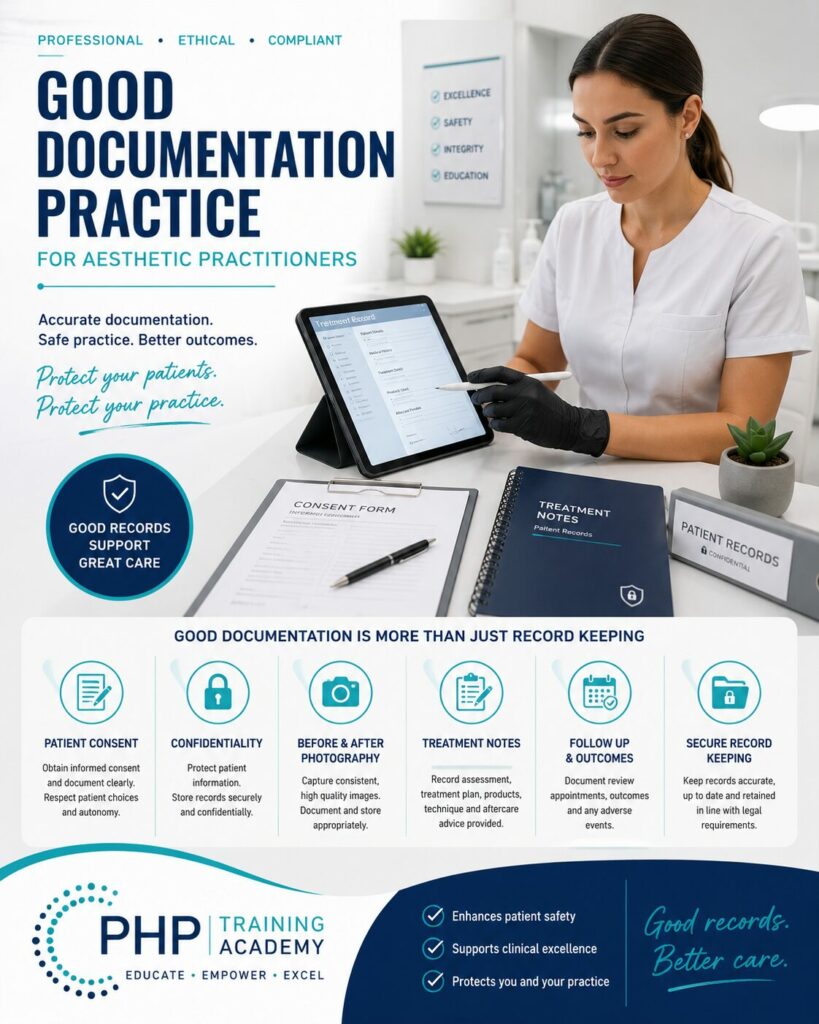
A defensible clinical note captures the whole encounter, not just the procedure. At each patient interaction, record the medical history, medications and allergies; the presenting concern and desired outcome; your contraindications assessment and examination findings; the treatment plan with risks and benefits discussed; the patient’s questions and your responses; the decision reached; the products used, including batch numbers, sites and volumes; post-treatment advice; and your name, signature and date.
A particular discipline matters here: if a treatment is declined or a contraindication is identified, document it and the reason. A blank space or missing entry will later be read as the check never having been performed.
Consent Is More Than a Signature
Consent is a process, and the signed form is only evidence that the process happened. Your records should demonstrate that sufficient information was given, in a way the patient could understand; that they had capacity; that the decision was made freely; and, as best practice, that a cooling-off period was offered. A compliant form describes the treatment, its benefits without guaranteeing results, its risks and adverse effects, and the alternatives — and for prescription-only medicines, confirms the medical assessment and prescription. If the underlying process was inadequate, the signature carries little weight.
Data Protection and Retention
Health records are ‘special category’ personal data under UK GDPR and the Data Protection Act 2018, carrying enhanced protection. In practice this means registering with the ICO, holding a lawful basis to process the data, providing a clear privacy notice, storing records securely, and responding to a Subject Access Request within one month. A data breach likely to pose a risk to individuals must be reported to the ICO within 72 hours.
Retention periods matter too. As a general guide, adult clinical records are kept for a minimum of eight years from the last contact; children’s records until age 25; and prescription records for at least two years, though longer is prudent. Where guidance offers a range, the longer, best-practice period is the safer choice for an aesthetic clinic.
Never alter a record after the fact. A correction is made with a single line through the original, the amendment, and your initials and date. Falsification is a criminal matter and a career-ending one.
Adverse Events and the Duty of Candour
When something goes wrong, the duty of candour requires you to tell the patient, apologise (an apology is not an admission of liability), explain what happened, and set out what will be done next — and to document all of it. An adverse event record should include the date and time, a factual and objective description, the patient’s condition, the actions taken and any referral, the products involved with batch and expiry details, and confirmation that the patient was informed. Serious reactions to products should also be reported through the appropriate channel, such as the MHRA Yellow Card scheme.
Photographs and Standard Operating Procedures
Standardised before-and-after photographs — consistent position, lighting and background, without filters or retouching — are an essential clinical record, labelled with a patient identifier, date and treatment, and kept securely. Any use for marketing requires separate, explicit written consent. Underpinning all of this, a clinic should run on standard operating procedures: controlled documents with a title, version, author, review date and clear steps, reviewed at least annually, so that good practice is consistent rather than dependent on memory.
Learn this properly with PHP Training Academy
Good Documentation Practice in Aesthetic and Healthcare Practice
, covers everything above in depth — ALCOA+, consent, data protection, adverse-event recording, SOPs and more — as online self-study with a certificate on completion. It is designed to help you document to a professional, legal and defensible standard.
Key Takeaways
Good documentation is not an administrative afterthought; it is a core clinical skill and one of the clearest markers of a professional practitioner. Record contemporaneously, completely and honestly; treat consent as a process; protect and retain data correctly; and never alter the past. Do this consistently and your records will do exactly what they are meant to do — protect your patients, support their care, and stand as your defence if you are ever challenged.
References & Further Reading
Authoritative sources on documentation, data integrity and record-keeping standards. Confirm the current version of each before relying on it in practice.
- MHRA.
‘GXP’ Data Integrity Guidance and Definitions — the source of the ALCOA+ principles for data integrity. - ICH.
Good Clinical Practice guideline (E6) — foundational documentation and source-data principles. - General Medical Council (GMC).
Good medical practice — standards on clinical records and consent. - Nursing & Midwifery Council (NMC).
The Code — guidance on record-keeping. - General Pharmaceutical Council (GPhC).
Standards for pharmacy professionals and registered pharmacies. - Information Commissioner’s Office (ICO).
Guidance on UK GDPR, special category health data and Subject Access Requests. - Care Quality Commission (CQC).
Regulations on good governance and records. - Joint Council for Cosmetic Practitioners (JCCP).
Standards and guidance for the cosmetic and aesthetic sector.
This article is for professional education and general guidance only. It does not replace the current, authoritative guidance of your regulator, indemnity provider or relevant legislation, which practitioners are responsible for following.
- Good Documentation Practice
Online: records that stand up to inspection and complaints. - Consent, Ethics, Law & Safeguarding
Online: consent, advertising rules, remote prescribing and safeguarding.