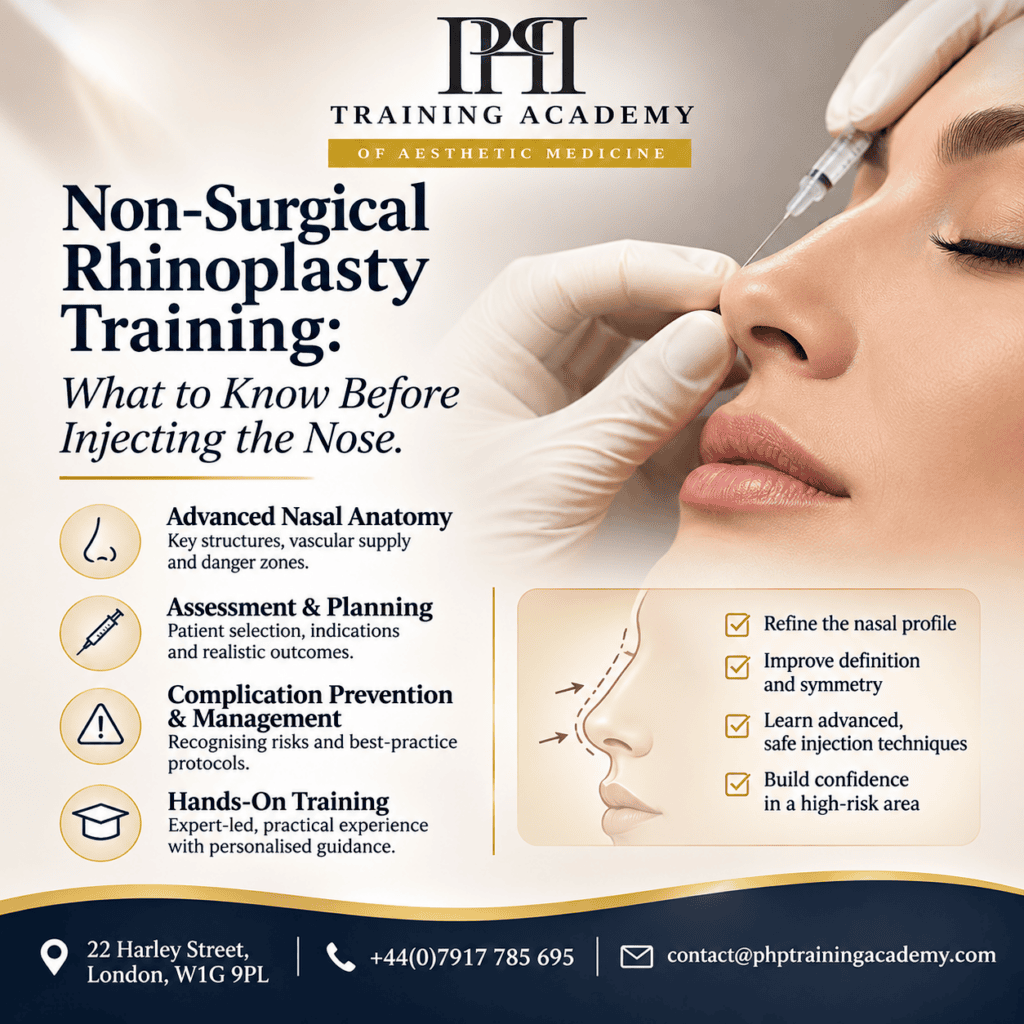
Non-Surgical Rhinoplasty Training: What to Know Before Injecting the Nose
Dermal Fillers · Patient Safety · Advanced Training
Non-Surgical Rhinoplasty Training What to Know Before Injecting the Nose
Nose filler is one of the highest-risk procedures in aesthetic medicine. Understanding nasal anatomy, selecting suitable patients and recognising complications are essential before offering this treatment.
By PHP Training Academy · 22 Harley Street, London · November 2026 · 7-minute read
Non-surgical rhinoplasty, also called nose filler or liquid rhinoplasty, uses dermal fillers to change the appearance of the nose without surgery.
It may improve the appearance of a dorsal hump, enhance projection or refine selected aspects of the nasal profile. However, it cannot make the nose physically smaller or replace surgical rhinoplasty where structural changes are required.
Although the procedure is minimally invasive, the risks are significant. Accidental injection into a blood vessel can cause vascular occlusion, tissue damage and, in rare cases, permanent vision loss or stroke.
These complications explain why non-surgical rhinoplasty requires advanced training, clinical judgement and appropriate emergency preparation.
References: Sansome et al. (2026) [1]; Murray et al. (2021) [2].
The short answer
Non-surgical rhinoplasty is not a beginner’s treatment. Practitioners should already have substantial experience in dermal filler treatments before undertaking advanced nasal injection training.
A suitable course should include detailed nasal and vascular anatomy, patient assessment, appropriate product selection, complication prevention, emergency management and supervised practical training.
Most importantly, practitioners must understand that no injection technique or anatomical plane completely removes the risk of vascular complications.
1. Why Is the Nose a High-Risk Injection Area?
The nose has a complex vascular network with connections to the circulation supplying the eyes. Three particular considerations make nasal filler procedures challenging.
👁️
Connections between nasal and ophthalmic arteries
The dorsal nasal, angular and other facial arteries have connections with the ophthalmic circulation.
If filler enters an artery, it can obstruct blood flow. In certain circumstances, filler may reach vessels supplying the retina, causing sudden and potentially permanent loss of vision.
🧬
Complex and variable anatomy
Nasal anatomy varies between patients. Previous surgery, trauma, scarring and earlier filler treatments may change tissue characteristics and vascular relationships.
Practitioners cannot rely on a single anatomical diagram or assume that a particular injection depth is safe for every patient.
📏
Limited tolerance for error
The nose contains areas where skin and underlying structures are closely connected. Excessive pressure, unsuitable product placement or vascular compromise can have serious consequences.
Even where no medical complication occurs, inappropriate treatment may produce an unnatural appearance or worsen nasal proportions.
⭐ Clinical principle: a detailed understanding of anatomy reduces risk but does not eliminate it.
References: Sansome et al. (2026) [1]; Murray et al. (2021) [2].
Read more: Facial Anatomy for Safe Injecting: The Danger Zones
2. Who Should Undertake Non-Surgical Rhinoplasty Training?
This advanced procedure is intended for experienced healthcare professionals with established competence in dermal filler treatments. Relevant professional registration may include:
✔ General Medical Council (GMC): doctors.
✔ General Dental Council (GDC): dentists.
✔ Nursing and Midwifery Council (NMC): nurses and other eligible registered professionals.
✔ General Pharmaceutical Council (GPhC): pharmacists.
However, professional registration alone does not establish competence to perform nasal filler procedures.
Practitioners should also have completed appropriate foundation and advanced filler training, gained substantial independent clinical experience, and developed the ability to recognise and manage filler-related complications. They must have suitable professional indemnity insurance covering the proposed procedures and practise within their competence.
At PHP Training Academy, applicants for the Non-Surgical Rhinoplasty Masterclass must demonstrate appropriate previous training and experience before acceptance.
⭐ A course that accepts complete beginners for advanced nasal filler procedures should raise serious concerns.
3. Six Essential Components of Good Rhinoplasty Training
Essential 1
Advanced Nasal and Vascular Anatomy
Training should cover the relevant bones, cartilage, soft tissues, vascular supply and anatomical variations.
Delegates must understand the relationship between nasal vessels and the ophthalmic circulation, including why vascular complications can affect vision.
The limitations of anatomical landmarks and so-called safe injection planes should also be explained.
Essential 2
Patient Assessment and Selection
Not every patient is suitable for non-surgical rhinoplasty. A comprehensive assessment should consider the patient’s concerns, expectations, medical history, previous treatments and nasal anatomy.
Particular care is needed where there has been previous nasal surgery, trauma, scarring or filler treatment.
Practitioners must recognise when treatment should be declined or when referral for a surgical opinion is more appropriate.
Essential 3
Product Knowledge
Training should explain the characteristics of different hyaluronic acid fillers, including their rheological properties, tissue behaviour and suitability for particular clinical objectives.
Product selection must take account of the individual patient, treatment area, product instructions and associated risks. No filler should be described as completely safe for nasal injection.
Practitioners must also understand the additional difficulties associated with managing complications from permanent or non-hyaluronic acid fillers.
Essential 4
Clinical Technique and Treatment Planning
A good course should teach careful assessment, treatment planning and the principles of controlled product placement.
This includes understanding the anatomical and clinical considerations involved in dorsal augmentation, tip refinement and other nasal treatment areas.
Training should emphasise conservative decision-making, avoiding unnecessary treatment and recognising when a proposed correction is unsuitable.
Essential 5
Vascular Complications and Emergency Management
This is one of the most important parts of advanced filler training.
Practitioners must recognise warning signs of vascular compromise, which may include unusual pain, blanching, mottled skin, delayed capillary refill and changes in skin colour. Training must also address sudden visual disturbances, eye pain and neurological symptoms.
Hyaluronidase is an important treatment in the management of suspected hyaluronic acid filler-related skin vascular occlusion. Practitioners must be trained in its appropriate emergency use. However, hyaluronidase should not be presented as a guaranteed treatment for filler-induced blindness.
⚠️ Suspected visual loss or neurological involvement requires immediate emergency hospital assessment. Treatment in the clinic must not delay emergency transfer.
A complete emergency protocol should cover recognition, initial management, escalation, referral, documentation, patient communication and follow-up.
References: Murray et al. (2021) [2]; Sansome et al. (2026) [1].
Read more: Managing Vascular Occlusion
Essential 6
Supervised Practical Training
Theoretical knowledge alone is not enough to establish clinical competence.
Practical training should provide opportunities to observe patient assessment, discuss treatment planning and undertake appropriate supervised clinical procedures. Small groups allow closer supervision, individual feedback and meaningful discussion of clinical decisions.
Practical assessment should evaluate more than technical injection ability. It should also consider patient selection, informed consent, recognition of complications and safe clinical judgement.
4. Warning Signs When Choosing a Course
Before booking an advanced rhinoplasty course, consider whether the provider:
✖ Accepts practitioners without adequate previous filler experience.
✖ Provides insufficient teaching on vascular anatomy and complications.
✖ Offers no meaningful supervised practical training.
✖ Uses large groups with limited individual supervision.
✖ Fails to explain emergency procedures and referral pathways.
✖ Awards certificates without appropriately assessing competence.
✖ Does not clearly explain the course prerequisites, scope or learning outcomes.
⭐ A certificate of attendance or CPD participation should not be confused with independent clinical competence.
Read more: How to Choose an Aesthetics Course: Six Questions to Ask Before You Book
5. PHP Training Academy: Non-Surgical Rhinoplasty Masterclass
Advanced Dermal Filler Training at 22 Harley Street, London
PHP Training Academy offers an advanced Non-Surgical Rhinoplasty Masterclass for experienced practitioners seeking to develop their knowledge and practical skills.
The course is taught by Dr Philippe Hamida-Pisal and forms part of the Academy’s progressive dermal filler training pathway.
Course details
✔ Duration: one full day, 09:00 to 17:00.
✔ Location: 22 Harley Street, London W1G 9PL.
✔ Group size: maximum six delegates.
✔ Practical training: supervised treatment on live models.
✔ Course materials: nasal anatomy manual, vascular emergency protocol card and consent template.
✔ Certification: CPD-certified Masterclass certificate.
✔ Eligibility: prior dermal filler training (Dermal Fillers Beginners and Cheek & Tear Trough, or equivalent) and substantial independent clinical experience are required.
Course fees
| Training option | Standard price | SoMUK member price |
|---|---|---|
| Group Masterclass | £1,000 + VAT | £800 + VAT |
| One-to-one Masterclass | £2,000 + VAT | £1,600 + VAT |
SoMUK members receive a 20% discount; membership is verified at the time of booking. All prices exclude VAT.
View the Non-Surgical Rhinoplasty Masterclass → View the Full Training Price List
Final thoughts: anatomy first, safety always
Non-surgical rhinoplasty requires more than technical confidence. It demands a thorough understanding of vascular anatomy, appropriate patient selection, informed consent, realistic treatment planning and the ability to respond immediately when complications occur.
Advanced training should build on existing clinical experience rather than replace it.
The aim is not simply to learn how to inject the nose. It is to understand when treatment is appropriate, when it should be avoided and how to protect patients if something goes wrong.
At PHP Training Academy, patient safety and responsible clinical practice remain central to advanced aesthetic education.
Anatomy first. Judgement before technique. Safety always.
Medical References
[1] Sansome S, et al. (2026). Consensus Guidelines for the Management of Tissue Filler-Induced Vision Loss in the United Kingdom. Aesthetic Surgery Journal, 46(5), 563–568.
doi.org/10.1093/asj/sjag002
[2] Murray G, Convery C, Walker L, Davies E. (2021). Guideline for the Management of Hyaluronic Acid Filler-induced Vascular Occlusion. Journal of Clinical and Aesthetic Dermatology, 14(5), E61–E69.
pmc.ncbi.nlm.nih.gov/articles/PMC8211329
Continue learning
Facial Anatomy for Safe Injecting: The Danger Zones →
Most Aesthetic Complications Are Not Caused by Bad Injecting →
PHP Training Academy
22 Harley Street, London W1G 9PL
Email: contact@phptrainingacademy.com · Telephone: +44 (0)7917 785 695
Website: www.phptrainingacademy.com
Educational disclaimer: This article is intended for appropriately qualified healthcare professionals. It provides general educational information and does not replace supervised practical training, individual clinical assessment, professional guidance or an established emergency management protocol.