Managing the Unhappy Patient
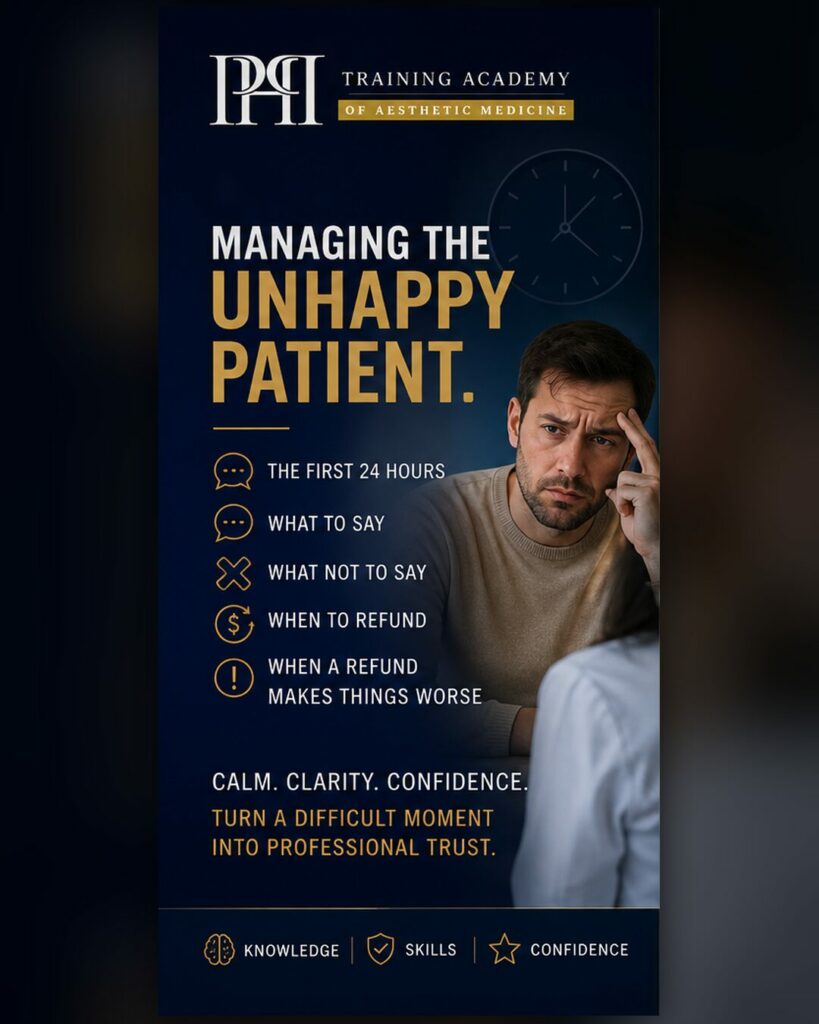
Managing the unhappy patient. Clinical Practice · Complaints · Patient Safety. Most complaints in aesthetic medicine are not really about the injection, but about what the practitioner did, or failed to do, in the days that followed.
Managing the Unhappy Patient: The First 24 Hours, and What Happens Next
Most complaints in aesthetic medicine are not really about the injection. They are about what the practitioner did — or failed to do — in the days that followed. A practical guide to triage, language, refunds, insurers and documentation.
Every injector will one day open a message that begins
“I’m really not happy with…”
It is not a sign of incompetence. It is a statistical certainty of doing enough treatments. What separates the practitioner who resolves it in a fortnight from the one who receives a letter of claim eighteen months later is almost never technical skill. It is how the first 24 hours were handled.
This article sets out a practical structure: how to triage what you are actually dealing with, what to say and what never to say, when a refund helps and when it makes things considerably worse, and what your records must show if the matter goes further.
The complaint is rarely about the needle
Analyses of complaints across healthcare consistently find that patients pursue formal action not because something went wrong, but because of what happened afterwards: they felt dismissed, they could not get hold of anyone, they were given a different explanation each time, or they sensed the practitioner was protecting themselves rather than helping. Poor outcomes are forgiven far more often than poor handling.
The corollary is encouraging. You do not need a perfect complication rate to have a clean complaints record. You need a reliable process that starts the moment the patient tells you they are unhappy.
The first rule: see them
Bring the patient in. In person, that day or the next, without charge, in a private room with adequate time. Do not attempt to manage an unhappy patient by WhatsApp, text or email, and do not let a receptionist or a social media account handle the first response.
There are three reasons, and all three matter. Clinically, you cannot exclude a vascular event, an infection or an inflammatory nodule from a photograph sent at 11pm. Legally, a written exchange composed under stress becomes disclosable evidence and rarely reads well a year later. Practically, a patient who is seen quickly and taken seriously is usually no longer an angry patient by the end of the appointment.
Keep a genuine same-or-next-day review slot available. A patient told “the first appointment is in three weeks” has been given three weeks to research solicitors, photograph themselves hourly and post about you. Availability is a risk-management tool, not a courtesy.
Triage: three different problems wearing the same face
Before you respond to the emotion, work out which of three situations you are in. They look identical at the front desk and require completely different management.
| What it is | How it presents | What it needs |
|---|---|---|
| A complication | Pain out of proportion, blanching, dusky or mottled skin, delayed capillary refill, visual change, spreading erythema, fever, fluctuance, a firm tender nodule, asymmetric ptosis | Immediate clinical management to your complications protocol. Time-critical. Nothing else in this article takes priority over this. |
| An expected outcome the patient was not prepared for | Bruising, swelling, palpable product at two days, toxin not yet working at day five, mild asymmetry during onset | Explanation, examination, reassurance and a booked review at the correct interval. Usually resolves with time and contact. |
| Unmet expectation | Treatment performed as agreed and settled, but the patient wanted a different result, or a larger one, or believes they were promised something else | A conversation about what was agreed, what was documented, and what is realistically achievable. This is the group where refunds, complaints and reviews arise. |
Say the category out loud in your own head before you speak. A great many complaints escalate because a practitioner reassured a complication or clinically over-treated a disappointment.
What to say
The aim of the first conversation is not to win it. It is to make the patient feel heard, establish the facts, and take control of the next step. Listen first, without interrupting, for longer than feels comfortable. Then examine. Then speak.
“Thank you for coming in so quickly. Tell me what you’ve noticed, from the beginning — I’m not going to interrupt.”
“I’m sorry you’ve been worried about this. That’s not the experience I want you to have.”
“Let me examine you properly and take some photographs, and then I’ll tell you honestly what I think is happening.”
“Here is what I think this is, here is what I expect over the next two weeks, and here is what we will do if that doesn’t happen.”
“I’d like to see you again on [date]. If anything changes before then, you call me on this number, not the reception line.”
Note what those sentences have in common. They express regret for the patient’s
experience
without asserting or denying fault, they commit to a defined plan with a date, and they give a route back to you. An apology for someone’s distress is not an admission of liability — and in the UK, regulated providers are expected to be open and apologise when something goes wrong, under the duty of candour.
1
What not to say
- “That’s completely normal.”
— said before examining. If you are wrong, you have delayed treatment and destroyed your credibility in one sentence. - “You signed the consent form.”
— the fastest way to convert a disappointed patient into a litigant. Consent is a process you can evidence, not a shield you wave. - “I’ve done thousands of these and never had a problem.”
— the patient hears:
therefore the problem is you
. - “Let’s just put a bit more in and see.”
— treating an unhappy patient on the day, to make the appointment end, is how a small problem becomes a large one. - “Whoever did your last treatment has caused this.”
— speculation about a colleague’s work, offered without records, is professionally risky and rarely accurate. - Anything at all in a public reply to a review
that confirms the person was a patient or discloses clinical detail — that is a confidentiality breach regardless of what they posted first. - “I’ll refund you if you take the post down.”
— a payment conditional on silence is indefensible if it is ever disclosed, and it will be.
Time is a clinical tool — but only if you use it deliberately
A great many complaints are made during the window in which the treatment has not yet finished declaring itself. Botulinum toxin should be judged at two weeks, not at day four, and a top-up assessment belongs at that point. Hyaluronic acid filler carries oedema that can take a fortnight to settle, and product that is palpable at 48 hours may be undetectable at three weeks. Bruising follows its own timetable irrespective of technique.
The distinction that matters is between
using
time and
hiding behind
time. “Give it a couple of weeks” said down the phone is hiding. The same interval, given after an examination, with the reasoning explained, a photograph taken and a review appointment already in the diary, is clinical management — and the patient can feel the difference.
Correcting, dissolving, or waiting
When the outcome genuinely is not what was agreed, resist the urge to act immediately. Decide at the review, not at the confrontation.
- ✓
Wait
where the finding is within the expected settling period, where inflammation is present, or where you are not yet certain what you are looking at. - ✓
Correct
where a defined, modest adjustment will achieve the agreed result — and where the patient understands this is a refinement, not a rescue. - ✓
Dissolve
where hyaluronic acid filler is genuinely the problem, the patient has been consented for the realistic consequences of hyaluronidase (including over-dissolution, a temporarily deflated appearance, the possible need for more than one session and the fact that it does not work on non-HA products), and a prescriber has assessed and prescribed. Hyaluronidase is a prescription-only medicine and its use in this indication is off-label.
2 - ✓
Stop and refer
where the product is unknown or non-biodegradable, where there is infection or a suspected biofilm, or where the problem is outside your competence. Knowing a colleague who takes these referrals is part of being safe to practise.
Refunds: when they help and when they make things worse
A refund is a commercial decision, not a clinical one, and it should be made with a clear head. It is not an admission of negligence — but the way it is offered can make it look like one, or worse, look like a purchase of silence.
| A refund usually helps when | A refund usually makes things worse when |
|---|---|
| You did not deliver what was agreed — wrong area, wrong volume, a genuine service failure. | It is offered instead of an examination. The patient wanted to be taken seriously and has been paid off. |
| The therapeutic relationship has ended and neither of you wants further treatment. Refund, close the episode courteously, and offer a written summary for their next practitioner. | Clinical follow-up is still needed. Refunding does not discharge you from managing a complication you caused. |
| The sum is small relative to the time, stress and reputational cost of a protracted dispute, and you have decided that on the facts — not under pressure in the room. | It is conditional on a review being removed, a post being deleted or the patient staying silent. |
| Your own terms and conditions provide for it, and you are simply applying them consistently. | It is offered before you have told your insurer, on a case that may become a claim. |
Offer any refund in writing, in neutral language, stating what it covers and that it is offered in resolution of the treatment concerned. Do not attach conditions about publicity. If the sum is significant, or a complication is involved, speak to your insurer first — see below.
Tell your insurer early
Practitioners routinely make two errors here: they notify late, because they hope it will go away, and they settle informally, because it feels kinder. Both can prejudice cover.
Most medical malpractice policies in the UK are written on a
claims-made
basis and impose a duty to notify circumstances that might give rise to a claim — not merely claims that have arrived. A serious complication, a threat of legal action or a formal written complaint is a notifiable circumstance. Equally, most policies prohibit admitting liability or agreeing a settlement without the insurer’s consent. Read your own wording before you need it, and keep the notification line saved.
run-off cover if you change insurer or stop practising, whether your policy covers the specific treatments and products you actually use, whether it covers correcting other practitioners’ work, and whether your indemnity is adequate for your current scope. Practitioners are frequently uninsured for the very thing they are being sued over.
The formal complaint
If the patient puts it in writing, the informal phase is over and a defined process begins. Have one already written down, published, and short enough that you will actually follow it.
- Acknowledge quickly and in writing
— within two to three working days is reasonable practice. Say who is handling it and when they will respond substantively. - Investigate before replying.
Read the notes and the consent record, review the photographs, and speak to anyone else involved. Do not rely on memory. - Respond in full within a stated period
— commonly 20 working days for a complaint about care. If you need longer, say so before the deadline and give a new one. - Answer each point the patient actually raised
, in their order, in plain English. Where something fell short, say so, apologise and set out what you have changed. - Say what happens if they remain dissatisfied
— the relevant regulator or sector body, and, for a data protection concern, the Information Commissioner’s Office. Note that the ICO deals with information rights, not refunds or clinical outcomes.
If you are a CQC-registered provider and the incident meets the threshold, the statutory duty of candour applies: tell the patient in person as soon as reasonably practicable, apologise, explain what is known, follow it up in writing and record that you have done so.
1
Doctors, nurses, dentists and pharmacists also carry a professional duty of candour under their own regulators’ standards.
3
Online reviews and social media
A public review feels like the greatest injury and is usually the smallest. The reflex to correct the record in public is the single most damaging instinct in this whole area, because confirming that a named individual attended your clinic — let alone what was done — is a disclosure of confidential information that you cannot cure by pointing out that they disclosed it first.
“We take all feedback seriously and would like the opportunity to look into this properly. We can’t discuss any individual’s care in a public forum, but please contact the clinic directly at [address] and we will respond fully.”
Then do exactly that. Most reviews soften or disappear once the person is actually contacted. Never ask staff, friends or other patients to post rebuttals, and never offer an incentive for removal.
What your notes must show
The retrospective note written after a letter arrives is worth very little, and the metadata in your clinical software will show when it was created. Contemporaneous records are the whole of your defence.
- ✓
The consultation: what the patient asked for, what you assessed, what you advised was and was not achievable, and the alternatives discussed — including doing nothing. - ✓
Consent: the specific risks discussed, in your words, not merely the fact that a form was signed. Record any off-label use and that it was explained. - ✓
The treatment: product, batch or lot number, expiry, dilution, total units or millilitres, sites, depth, technique, needle or cannula, and who performed it. - ✓
Standardised photographs before and after, in consistent lighting and position, dated. - ✓
Aftercare given and the review interval booked. - ✓
Every contact after the treatment — including calls, texts and messages — with the date, who spoke, what was said and what was agreed. Save the message threads themselves. - ✓
Your reasoning. A note that records
why
you decided to wait, correct or dissolve is far more persuasive than one that records only what you did.
Preventing the next one
Almost every unmet-expectation complaint is created before the needle is uncapped. The preventive work is unglamorous and highly effective:
- ✓
Say plainly what the treatment will
not
do. Patients remember the limitation far longer than the promise. - ✓
Never agree to reproduce a photograph of someone else’s face, and say why. - ✓
Point out pre-existing asymmetry at the consultation, with a mirror, and photograph it. Asymmetry you identify first is anatomy; asymmetry the patient identifies first is your complication. - ✓
Book the review appointment at the time of treatment, as standard, for everyone. It costs a slot and prevents a great deal. - ✓
Give a written aftercare sheet with a named contact and a route for urgent concerns out of hours. - ✓
Do not treat on the day of a first consultation where expectations feel uncertain. A cooling-off period filters out the appointments you would have regretted.
PHP Training Academy’s courses build complication recognition, consent and post-treatment management into every level — because technique alone does not keep practitioners safe. Ask us which course fits your current scope of practice.
References and further reading
- Care Quality Commission. Regulation 20: Duty of candour.
cqc.org.uk — regulation 20 - Human Medicines Regulations 2012 (SI 2012/1916) — provisions governing prescription-only medicines and their supply and administration.
legislation.gov.uk - General Medical Council. Good medical practice (2024), and Guidance for doctors who offer cosmetic interventions.
gmc-uk.org — cosmetic interventions - Joint Council for Cosmetic Practitioners (JCCP) and the Cosmetic Practice Standards Authority — standards, complaints expectations and the practitioner register.
jccp.org.uk - Information Commissioner’s Office — complaints about the handling of personal data.
ico.org.uk
This article is intended for registered healthcare and aesthetic practitioners and is provided for education only. It is not legal advice, insurance advice or a substitute for your professional obligations, your indemnity provider’s policy terms or your regulator’s current guidance. Practitioners remain responsible for working within their competence, scope of practice and the law in force at the time of treatment.
- Complications & Emergencies
Vascular occlusion, hyaluronidase, anaphylaxis and escalation, with scenario training. - Consent, Ethics, Law & Safeguarding
Online: consent, advertising rules, remote prescribing and safeguarding. - Good Documentation Practice
Online: records that stand up to inspection and complaints.