High-Risk Cosmetic Procedures Consultation 2026: What It Means for You
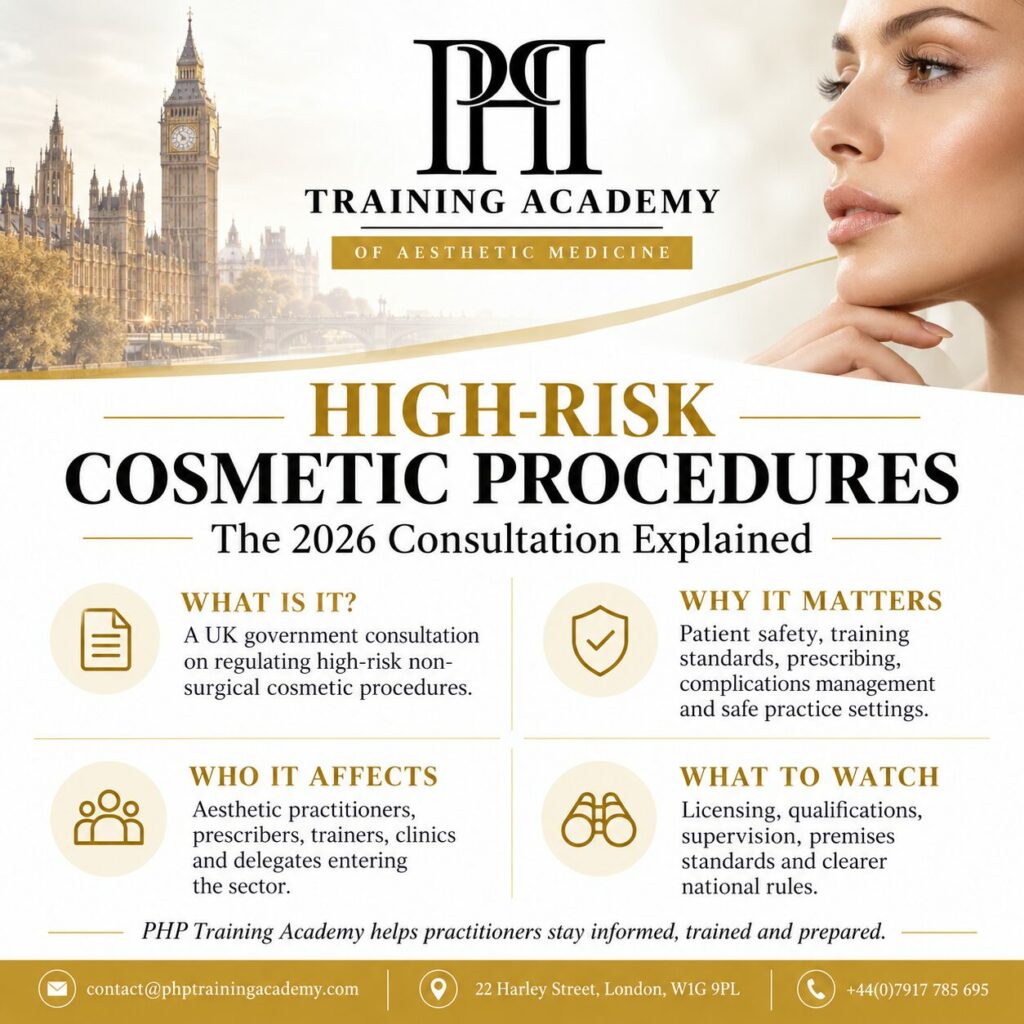
The 2026 Consultation Explained
What the government proposes for PRP, IV drips, deep peels and other high-risk treatments in England, who could still perform them, and what to do before 13 January 2027.
What Has Been Announced
The Department of Health and Social Care has published a consultation called Restrictions on the performance of high-risk cosmetic and wellbeing procedures in England. It sets out which procedures would be restricted, who could still perform them, and how the rules would be enforced, and asks practitioners, businesses and the public for their views. Read the consultation on GOV.UK.
- ✔Opened: 21 October 2026
- ✔Closes: 13 January 2027
- ✔Next step: draft regulations through Parliament, planned for spring 2027
- ✔Area: England only
Which Procedures Are Proposed as High-Risk
As reported at launch, the proposed list includes:
- ✔Cosmetic surgery, including dermal filler injected anywhere other than the face (such as the liquid BBL)
- ✔Blood procedures such as platelet-rich plasma (PRP), including “vampire facials”
- ✔Intravenous (IV) procedures, such as IV vitamin drips
- ✔Deep chemical peels
- ✔Non-resorbable (permanent) facial fillers
- ✔Dermal microcoring and subcision
- ✔Specified high-risk laser and intense pulsed light (IPL) treatments
- ✔Procedures that involve giving an anaesthetic as a separate injection
Who Could Still Perform Them
| Practitioner | High-risk procedures under the proposals |
|---|---|
| Doctors | Yes, with accredited training. Cosmetic surgery would be doctors only. |
| Dentists | Yes, with accredited training (not cosmetic surgery). |
| Independent-prescriber nurses, midwives and pharmacists | Yes, with accredited training (not cosmetic surgery). |
| Nurses, midwives and pharmacists who are not independent prescribers | Not under the proposals as reported. |
| Other healthcare professionals and non-healthcare practitioners | Not under the proposals as reported. |
What counts as “accredited training” is not yet defined. Nor do the early reports describe an option to perform these procedures under another professional’s supervision, so check the consultation if that is how you work today.
Age Limit and Enforcement
- ✔Procedures restricted to people aged 18 and over, with exceptions for NHS provision or treatment of a medical condition
- ✔Breaching the rules would be a criminal offence
- ✔Reported penalties range from fixed fines enforced by the CQC to an unlimited fine or up to 12 months in prison on conviction
How This Fits with the Licensing Scheme
This consultation deals with the highest-risk procedures. Botox, lip fillers and other lower-risk treatments are expected to come under the separate licensing scheme for practitioners and premises, which the government confirmed in 2025 and which is not yet in force. In short: high-risk procedures would be limited to named professionals; lower-risk treatments would need a licence. Our guide to UK aesthetics regulation and licensing explains the wider picture.
What It Means for You
If you are a doctor, dentist or independent prescriber
You would remain able to offer these treatments, provided your training meets the accreditation standard once it is defined. Keep a clear record of your training, competence assessments and certificates now: you are likely to need it.
If you are a nurse, midwife or pharmacist who is not a prescriber
PRP, IV drips and deep peels may no longer be open to you independently. Think about your options before investing in new equipment: an independent prescribing qualification, a role within a doctor-led or prescriber-led clinic, or focusing on treatments outside the high-risk list.
If you are planning your training
Choose training that would stand up to scrutiny: delivered by registered prescribers, with supervised treatment of real patients, a documented competence assessment and complications management. Ask any provider how they will respond once the accreditation standard is published.
What to Do Now
- ✔Read the consultation and respond before 13 January 2027: practitioners’ views shape the final rules
- ✔List which of your current or planned treatments appear on the high-risk list
- ✔Check your indemnity insurer’s position on those treatments
- ✔Gather your training records, certificates and competence sign-offs
- ✔Make sure complications and emergency training is current for every treatment you offer
Frequently Asked Questions
- PRP — Platelet-Rich Plasma
From blood draw to injection, for skin and hair. - Phlebotomy, Cannulation & IV Therapy
Confident venepuncture, cannulation and IV practice. - Complications & Emergencies
Vascular occlusion, hyaluronidase, anaphylaxis and escalation, with scenario training. - VTCT Skills (ITEC) Level 7 Diploma
The Ofqual-regulated qualification in toxins and fillers.
Sources
- GOV.UK: Restrictions on the performance of high-risk cosmetic and wellbeing procedures in England (consultation)
- Chemist+Druggist: Govt proposes restricting ‘high-risk’ cosmetic procedures to IPs (21 October 2026)
- Pulse: Government sets out detail of crackdown on cosmetic procedures (22 October 2026)
- House of Commons Library: The regulation of non-surgical cosmetic procedures in England